 I’m going to share a little secret with you:
I am absolutely terrified of heights.
Always have been.
And my dad knew this. So, when he taught me how to drive, he didn’t choose a quiet neighborhood. He guided me straight onto Newport Road — a narrow stretch that clung to the side of a cliff… and later over the Grand Island Bridges, which are high enough to let freighters slide underneath.
I cursed him along both trips.
But he wasn’t being cruel. He was using his military training.
He was teaching me something I didn’t fully grasp until much later:
Fear doesn’t get smaller until you move toward it.
And the fear of quilting is no different.
The Many Flavors of Quilting Fear
You don’t need to hang off a cliff to feel fear. Sometimes all it takes is a rotary cutter and a beautiful piece of fabric.
Quilters have their own alphabet of worries:
-
FOC — Fear of Cutting into a beautiful fabric and ruining it.
-
FOB — Fear of Binding and getting those mitered corners just right.
-
FOP — Fear of Piecing, especially partial seams or Y-seams.
-
FOA — Fear of Appliqué, when you see beautiful needle turn and aren’t sure you can do it.
-
FOQ — Fear of Quilting a top you spent so much time making… and accidentally ruining it.
Pick any three quilters and you’ll hear three different “nope, not doing that” stories.
We dream about projects all the time. We collect fabrics, sketch ideas (or buy the pattern), plan the layout. We picture the “after”… and then freeze before the “during.”
Not because we lack skill.
But because we care — and caring raises the stakes.
I understand that better than I’d like to admit.
Even with decades of sewing, designing, and experimenting behind me, I reached a moment where I realized something surprising:
I was afraid of quilting.
Me — the person who could cut, piece, and appliqué without hesitation — suddenly found myself terrified of quilting my carefully pieced tops. I didn’t want stitches that looked messy. I didn’t want thread that stood out too much. I didn’t want the quilt to look better before quilting than after.
Fear shows up quietly. But it shows up.
F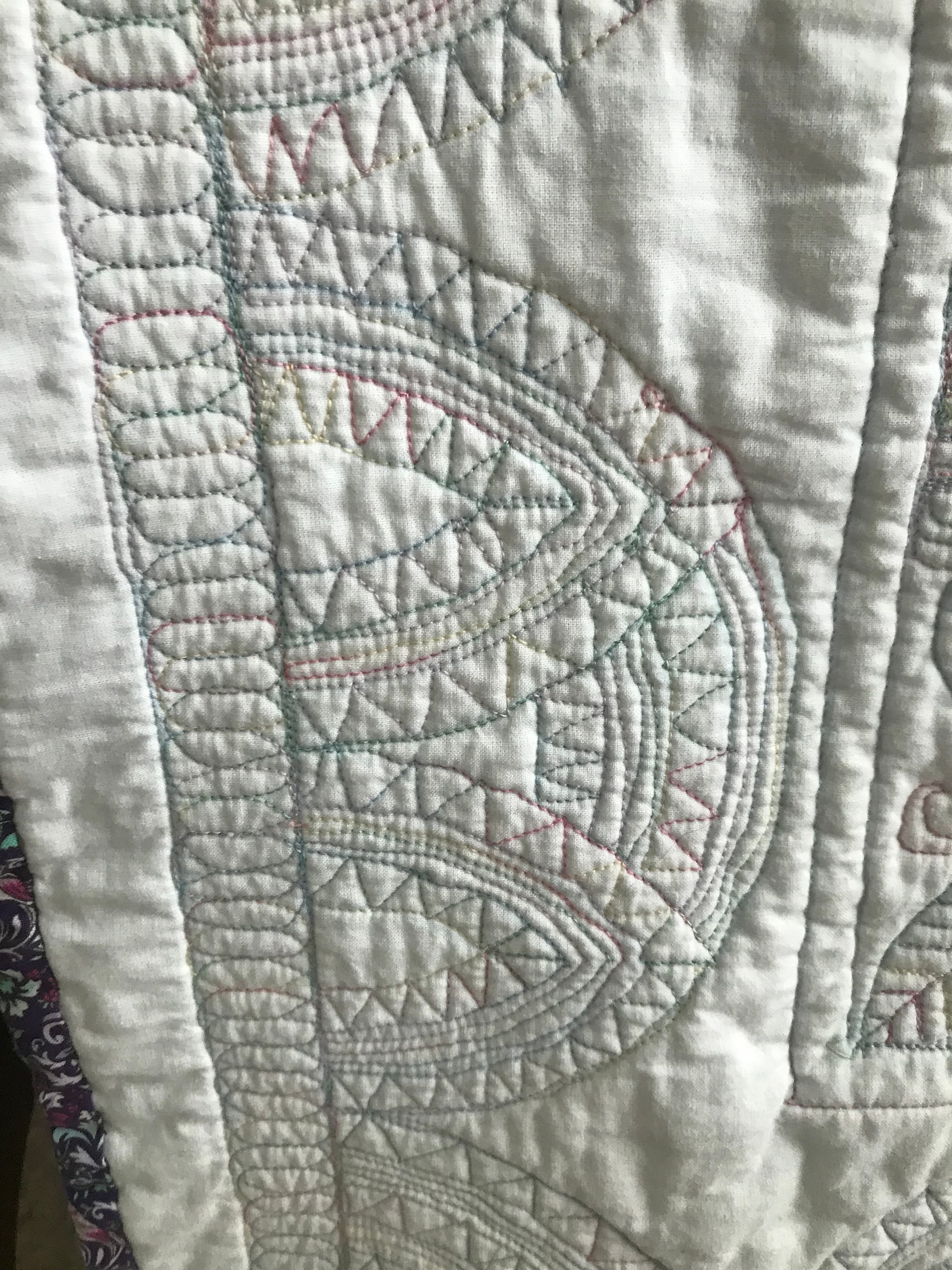 acing the Fear Head-On
Eventually, I recognized what was happening.
It was that same cliff-edge feeling.
The same heart-thumping pause before stepping forward.
So, I took my dad’s lesson and applied it here:
-
Pick something small.
-
Pick something manageable.
-
Pick something where the fear can’t do much damage.
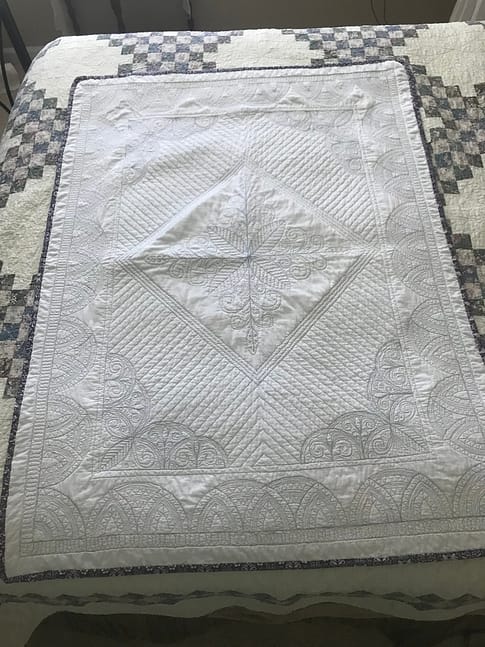
That’s how I ended up with a pre-printed wholecloth panel.
No cutting.
No piecing.
No color decisions.
No risk of undoing hours of appliqué.
Just thread, batting, backing, and a printed path to follow.
It was the quilting equivalent of driving across that bridge — except on a road with guardrails.
Wholecloth quilting lets you practice the skill without attaching it to high stakes. It’s a chance to play, test ideas, and build muscle memory without the pressure of perfection.
And as much as I love appliqué, piecing, and all the creative parts of quilting, I’ll be the first to say:
Skill grows when we play.
Wholecloth gave me space to play again. It wasn’t going to be a masterpiece, but it built my confidence.
So if you have a similar fear of quilting… let me share my journey.
Tools You’ll Need (Nothing Fancy)
Here’s exactly what I used to get started — nothing fancy, nothing intimidating:
-
a pre-printed wholecloth panel (I found mine at The Stencil Company)
-
batting (I used cotton because I like the crinkled texture after washing)
-
backing (a busy print hides early wobbles; solids show everything)
-
thread (I chose a variegated cotton because… why not?)
-
scissors for threads
-
a hoop (for hand quilting) or your machine (stationary or longarm)
That’s it.
You’re not committing to a full quilt.
You’re not risking your favorite fabrics.
You’re not promising this will become a gift or an heirloom.
You’re simply practicing quilting.
And removing consequences is a fantastic way to remove fear.
 Hand vs. Machine: Both Work
If you’re hand quilting:
-
use a simple running stitch
-
keep your stitches as even as feels comfortable
-
plan your route
-
bury your knots in the batting (not through the backing)
If you’re machine quilting:
-
backtracking is fine but keep it minimal
-
quilting over the same line makes it stand out
-
practice knot-burying here, too — no whiskers poking out later
Wholecloth pieces are excellent teachers. They let you pay attention to stitching, rhythm, tension, and path — without ten other decisions muddling your focus.
The Magic Moment
Once the quilting is done (and you’ve taken a breath), here’s the part most people find the most rewarding:
When you’re done quilting, it’s time to remove the stencil lines.
This part still amazes me.
A cold-water soak makes the printed lines disappear — like watching your fear dissolve right along with them.
You’re left with your stitches.
Your progress.
Your courage on display.
Whether you stitched every line exactly or added a little experimental flair (I certainly did), you now have something
your fear tried to talk you out of… and you did it anyway.
Give Yourself Permission to Play
Fear doesn’t vanish because we ignore it.
It shrinks because we give ourselves a safe place to try something new.
A wholecloth panel was that place for me.
It might be that place for you, too.
Whether your fear lives in cutting, binding, quilting, or somewhere else entirely… the only way out is forward.
Just like that drive on the cliff road.
Just like stepping onto a longarm for the first time.
Just like trusting yourself with a needle and thread.
Start small.
Start simple.
Start where the fear can’t do any real harm.
And then let your skills grow as you play.
You’ll surprise yourself — I promise.
This particular fabric was purchased from The Stencil Company. They have a wide variety of patterns, colors and sizes. Their website also had loads of ideas for future projects if you get hooked on quilting.
Your wholecloth is beautiful – very detailed, what an accomplishment. It looks like you may be mastering quilting with rulers.
Thank you! The straight lines are much easier with rulers. HandiQuilter as some great ones.