
A friendly guide to figuring out bed measurements, quilt size terms, and the tricks quilters use to avoid — or fix — a quilt that doesn’t quite fit.
This was one of my very first large quilts. (My sister owns the infamous first-first quilt — and trust me, that story is for another day. Looking back, it’s a classic case of getting in over your head before you realize how deep the quilting rabbit hole goes.)
Anyway… back to the quilt at hand.
I had fallen in love with a simple Triple Irish Chain pattern and some beautiful, muted fabrics. Yes, it was the 90s — the color palette absolutely gives it away. I pieced the whole thing together and spent weeks quilting it on my domestic machine. I stitched fancy flowers in every negative space, turning that quilt dozens of times for each motif because I had no idea what free-motion quilting was, let alone what a longarm could do for my sanity.
Then came the big moment.
I pulled it across my queen-sized bed, ready to bask in all that effort.
And… it didn’t fit.
It covered the length of the bed beautifully, but thanks to the pillow-top mattress (which I had blissfully ignored), it didn’t hang over the sides. Not even close.
 I wanted to cry.
All that work… and my sheets were peeking out for the world to see.
But the engineer in me refused defeat.
I turned the quilt ninety degrees. Suddenly it covered the sides and the bottom of the mattress. Problem solved… kind of. Now it was short at the top, so I tucked a warm blanket underneath and added a mountain of throw pillows to disguise the fact that the quilt was… well… a bit short.
And that’s how I learned: quilt size matters, and mattresses lie.
So, let’s chat about how to avoid that “oh noooo” moment — and how to fix it if it happens anyway.
1. How to Figure Out the Quilt Size You Actually Need
Before you ever choose fabric, cut a strip, or fall in love with a layout on Pinterest, you need to know one thing:
👉 What size does the quilt need to be for your bed?
Not “a typical queen.”
Not “whatever the pattern says.”
Not “what my guild friend swears works for her bed.”
Beds are like quilters — no two are the same.
Mattress depth, style, and toppers change everything.
Let’s walk through this the easy way.
Measure These Three Things (Yes, in This Order)
1️⃣ Mattress Width (W)
Left edge to right edge, across the top surface.
This is your anchor measurement and tells you how much overhang you’ll want.
2️⃣ Mattress Length (L)
Top to bottom.
Straightforward — but remember to measure where pillows will sit if you’re planning a pillow tuck.
3️⃣ Mattress Depth (D)
This is the troublemaker.
This is why my Triple Irish Chain failed its audition on my bed.
Not only would it show my sheets — it might have shown my bum in the middle of the night!
Modern pillow-top mattresses are 12–18 inches deep, sometimes more.
Most older quilt patterns assume 7–9 inches.
That difference alone can steal 8–16″ of side drop.
(Ask me how I know.)
Decide What “Look” You Want
Your drop — how far the quilt hangs down the sides and foot — determines the final size.
Pick your personality:
Comforter
Covers the top of the bed with a small drop.
Great for modern, streamlined rooms.
Coverlet
Covers mattress + box spring.
A tidy, finished look without touching the floor.
Bedspread
Drapes gracefully to the floor.
Traditional, elegant, and excellent for hiding under-bed chaos or the cat.
(Again, ask me how I know.)
Use These Easy Quilt-Size Formulas
Comforter Formula
Coverlet Formula
Includes mattress depth:
Bedspread Formula
Adds depth + drape to the floor:
Where F = floor drop (distance from box spring to floor).
A little quilty math now saves a lot of tears later.
A Quilter’s Reality Check
When in doubt:
-
Measure twice.
-
Add a little more drop than you think you need.
-
Jot it down in your project notebook (trust me, you’ll forget).
-
And trust your instincts — if it looks small across the bed, it probably is.
The good news?
Once you know your numbers, you can make any pattern work for any bed.
2. What Quilt Size Names Really Mean
Before we dive into the ranges, let’s clear up one important detail:
👉 When you see quilt dimensions listed (like 50″ × 60″), the first number is the width and the second number is the length.
Width = side-to-side
Length = top-to-bottom
Some patterns flip these numbers around (which drives me bananas), so this quick reminder helps you compare apples to apples.
With that out of the way, let’s break down the real-world sizes behind all those quilt labels. Quilt sizes sound straightforward… until you discover that a “throw” can be anything from petite-and-cute to blanket-for-a-giant, and a “queen” can vary by more than a foot depending on who wrote the pattern.
Here’s the quilter-to-quilter guide — practical, friendly, and rooted in real-world sizing, not fantasy catalog numbers.
Throws & Lap Quilts
Perfect for snuggling, gifting, charity projects, and adding color to a chair or room.
(And remember: width first, length second.)
Wheelchair / True Lap Quilt
36″–40″ × 40″–45″
Sized to sit comfortably across a lap without getting caught in wheels.
Ideal for nursing homes, hospitals, hospice donations, guild charity drives, and comfort quilts.
Small Throw
50″ × 60″
Great for kids, reading chairs, or a cozy, lightweight project.
Large Throw
60″–70″ × 70″–80″
A wonderfully versatile size for couch snuggling, chilly retreats, or staying warm in the bleachers at a Friday night football game.
TV/Couch Throw
50″ × 70″
Perfect for recliners and for that one family member who always steals the blanket.
Standard Bed Quilt Ranges
These are real-world measurements — not idealized catalog numbers. Always measure your own bed (see Section 1), but these ranges give you a practical starting point.
Twin
65″–72″ × 88″–95″
(Tip: many “twin” quilts end up too narrow for modern mattresses unless you plan your drop.)
Full/Double
80″–88″ × 88″–96″
Queen
88″–98″ × 94″–108″
The size with the most variation. Mattress depth and desired drop make a huge difference here.
King
100″–110″ × 94″–120″
California King
104″–114″ × 100″–120″
Longer and slightly narrower than a standard king — perfect for tall sleepers.
Table Toppers, Placemats & Runners
Because quilters don’t just make bed quilts — we make the whole house pretty.
Placemats (Rectangular)
-
12″ × 18″ (standard)
-
14″ × 20″ (oversized or decorative)
Placemats (Square)
-
12″ × 12″
Table Toppers
These are usually square or nearly square, perfect for the center of a table, coffee table, or small accent space.
-
Small Table Topper: 24″ × 24″
-
Medium Table Topper: 30″–36″ square
-
Large Table Topper: 40″–48″ square
Great for trying out a new block, showing off a seasonal print, or testing a color idea without committing to a full quilt.
These also make lovely wall hangings if you run out of horizontal surfaces.
Table Runners
Size depends on table length and the style you prefer (clean and modern vs. drapey and romantic).
-
Short Runner: 10″–14″ wide × 36″–48″ long
-
Dining Table Runner: 12″–16″ wide × 60″–72″ long
-
Long/Extended Table: up to 90″ long
-
Skinny Runner: 8″–10″ wide × 40″–72″ long
Style Tip: For edge drape, add 6–12 inches to each end.
These also make great wall hangings for narrow wall spaces.
Bed Runners
Absolutely brilliant if a quilt comes out a bit short — or if you want a quick way to add color without making a full quilt.
-
20″–30″ wide
-
60″–100″ long
They’re like table runners for your bed, but with more personality and fewer candle drips.
Quick Reality Check
Patterns will label a quilt as “throw” or “queen,” but you get to decide the actual size that works for your bed, your body, and your space.
These labels are guidelines.
Your measurements (from Section 1) are the truth.
3. How to Make a Quilt Bigger Before You Start
Sizing your quilt at the beginning is far easier (and less emotional!) than trying to fix it at the end.
Here are the simplest, smartest ways to scale a quilt before you cut a single strip. Or at least before you quilt it!
Option A: Add Borders (The Classic Fix That Always Works)
Borders are the easiest way to increase size—if you keep them intentional.
Ways to use them:
• Add a single wide border
Great when you love your layout but need more drop.
• Add multiple narrow borders
Creates a framed, cohesive look.
• Add a pieced border
Echo motifs, colors, or shapes from the quilt center to maintain the aesthetic.
(This is the difference between “designed choice” and “I ran out of fabric and panicked.”)
• Add Partial Borders / Side Extensions
Sometimes you only need width or length—not both.
Narrow vertical or horizontal extensions can help without overwhelming the quilt.
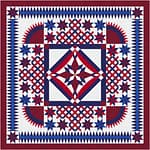
Border Reminder:
Each 6″ border adds 12″ to the width and 6″–10″ to the length (depending on foot drop).
-
- Never Forget
-

- Never Forget with Borders
Option B: Increase the Block Count (Rows or Columns)
If the quilt uses a grid layout, this is an easy way to grow evenly:
-
Add a column → increases width
-
Add a row → increases length
Just make sure to:
👉 Adjust your borders as well so everything stays balanced.
A single row and column of 12″ blocks can add 24″ in both directions — a huge help for queen and king quilts.
Option C: Add or Widen Sashing
Sashing is one of the easiest ways to adjust size without changing blocks.
You can:
-
Add sashing where none existed
-
Widen the existing strips
-
Add sashing only between rows or only between columns
-
Use cornerstones to unify the palette
Important design note:
Wider sashing may shift the visual balance of the quilt, especially in designs with a strong secondary pattern.
But it works beautifully for:
-
Signature quilts
-
Block collections
-
Samplers
-
Memory quilts
And it’s perfect when blocks need “breathing room.”
Option D: Increase the Block Size
Same design, bigger final quilt.
This is particularly helpful for simple or traditional blocks.
How to do the math:
Take the finished block size and multiply by the factor you want to increase:
Example:
6″ block → 9″ block
9 ÷ 6 = 1.5
Now multiply every piece in the block by 1.5, then add your ¼” seam allowance on each side.
So a 2″ finished square becomes:
2 × 1.5 = 3″ finished
-
½” seam allowance
= 3½” cut size
Be prepared with your ruler—this method works beautifully once you get the hang of it.
A Little Planning Goes a Long Way
Making size adjustments before you start sewing gives you:
-
A better-fitting quilt
-
A more intentional design
-
More control
-
Less panic
-
And a quilt that feels finished the way you envisioned it
And best of all:
👉 Once you learn these techniques, you can resize almost any pattern with confidence.
4. How to Fix a Quilt That’s Already Too Small
So the quilting is done… maybe even the binding too.
You lay it on the bed and—ugh.
Your quilt is adorable, but your sheets are waving hello.
Or worse… you can still see the storage bins under the bed.
We’ve all been there.
The good news?
You still have options — some simple, some… more “weekend project.”
Let’s walk through them from easiest to hardest.
Option A: Layer with a Coverlet or Dust Ruffle (Easiest Fix)
This is the quickest way to fake a perfect fit with no extra quilting.
You can:
-
Put a coordinating coverlet or duvet on the bed first
-
Or add a dust ruffle to hide the mattress, box spring, and storage bins
Then use your too-small quilt as:
-
The main quilt, centered nicely
-
A decorative layer folded at the foot of the bed
-
An accent thrown across the middle
Your eye reads the whole bed as “finished,” and the quilt gets to be the star, not the problem.
Option B: Rotate the Quilt (If the Design Allows)
Sometimes the quilt’s proportions make more sense turned 90 degrees.
This can help if:
-
The design isn’t directional
-
The quilting looks okay both ways
-
You need more drop on the sides than at the foot
This is exactly what I did with my Triple Irish Chain.
It fit the length of the bed just fine but was embarrassingly short on the sides.
So I turned it 90 degrees—suddenly the sides were covered and it looked much better.
(Was it still a little short at the head? Yes. Did a warm blanket and a pile of throw pillows fix that? Also yes.)
It won’t work for every quilt, but when it does, it’s a very satisfying save.
Option C: Do a Little Quilt Surgery (Add Extra Border After Quilting)
This is the “I love this quilt too much to give up” option.
If you’re willing to do some sewing, you can carefully add size after the fact:
-
Remove the binding
-
Add a narrow framing strip or wider border where needed (sides, bottom, or all around)
-
Butt additional batting to the existing edge with a zigzag stitch
-
Add backing fabric to extend the quilt
-
Quilt only the new border area, echoing or complementing your original design
-
Rebind the entire quilt
It’s more work, but it preserves your original quilting and gives you the extra inches you need.
Think of it as a revision, not a failure.
When All Else Fails… Give the Quilt a Different Job
Sometimes the quilt isn’t meant to be a bed quilt at all.
It might be happier as:
-
A couch or recliner throw
-
A porch-swing quilt
-
A reading-chair quilt
-
A guest-room accent
-
A retreat/travel quilt
-
A football-bleacher warmer
-
A trunk-show or class sample
Quilts have a funny way of finding their place.
Just because it doesn’t fit the bed doesn’t mean it isn’t exactly right for something.
Wrapping It All Up
Quilt sizing isn’t glamorous… but it is one of those behind-the-scenes skills that makes everything else smoother.
Whether you’re planning a brand-new project or staring down a quilt that came out adorably—but inconveniently—small, you now have the tools to get the look and fit you want.
Because here’s the thing:
👉 Every quilt can be the right size with a little planning or a little creativity.
If you’ve ever made a quilt that didn’t quite fit the way you imagined (and who hasn’t?), you’re in very good company. We’ve all been surprised by mattress depths, pattern assumptions, and that one time we forgot to measure the bed at all.
(Ahem… Triple Irish Chain.)
Your quilts deserve to shine—whether on a bed, a couch, a chair, or in the hands of someone you love.
Grab These Free Guides
These two quick-reference sheets will make your next quilt-size decision so much easier:
📥 Download #1: The Quilt Measurement Guide
A simple one-page reference for measuring your bed correctly (width, length, depth, and drop), plus formulas for comforters, coverlets, and bedspreads.
[Download Quilt Measurement Guide]
Perfect for your project notebook or taping inside a sewing cabinet door.
📥 Download #2: Common Quilt Sizes Chart
A clean, visual chart of standard dimensions for throws, lap quilts, bed quilts, table toppers, runners, and placemats.
Great for planning, modifying patterns, and choosing sizes for gifts.
Your Turn!
What’s your biggest quilt-sizing surprise?
Did you ever finish a quilt only to discover the bed had other opinions?
Tell me in the comments — your stories often spark ideas for future posts (and reassure other quilters they’re not alone).
Happy Quilting 🙂
